Showing posts with label health. Show all posts

Monday, November 30, 2015

Untreated Mental Illness Plus Guns

After Aurora, a Colorado Springs reporter wrote, "James Holmes, the man accused of killing 12 people and wounding 58 at an Aurora movie theater, was seeing a psychiatrist at the time of the July 20 attack. If he’d been in Colorado Springs, chances are he wouldn’t have gotten even that much help."

After an October incident in Colorado Springs where a guy with a rifle and gas cans opened fire on civilians in the street, the local gun-nut mag noted that someone with an open-carry gun plus gas cans might be worrisome and require some level of serious response even as they applauded the mayor of Colorado Springs for not budging on the open-carry law.

Now that same mayor says about the most recent mass killing in Colorado Springs, the second in a month, that "one of the things we don’t do very well is identify these people, sometimes with mental health problems, and prevent their access to weapons."

Well, yes. We don't identify them, we don't treat them, and we don't prevent their access to weapons.

Adam Lankford at the U of Alabama has done the most interesting recent work on mass killings. He used a definition of four or more kills, meaning that the recent Colorado Springs shootings wouldn't even appear on his radar. (The FBI uses three or more.) Nevertheless, he found that the US accounted for 31 percent of mass shootings, and that the only real predictive correlation with any meaning was our firearm ownership rate.

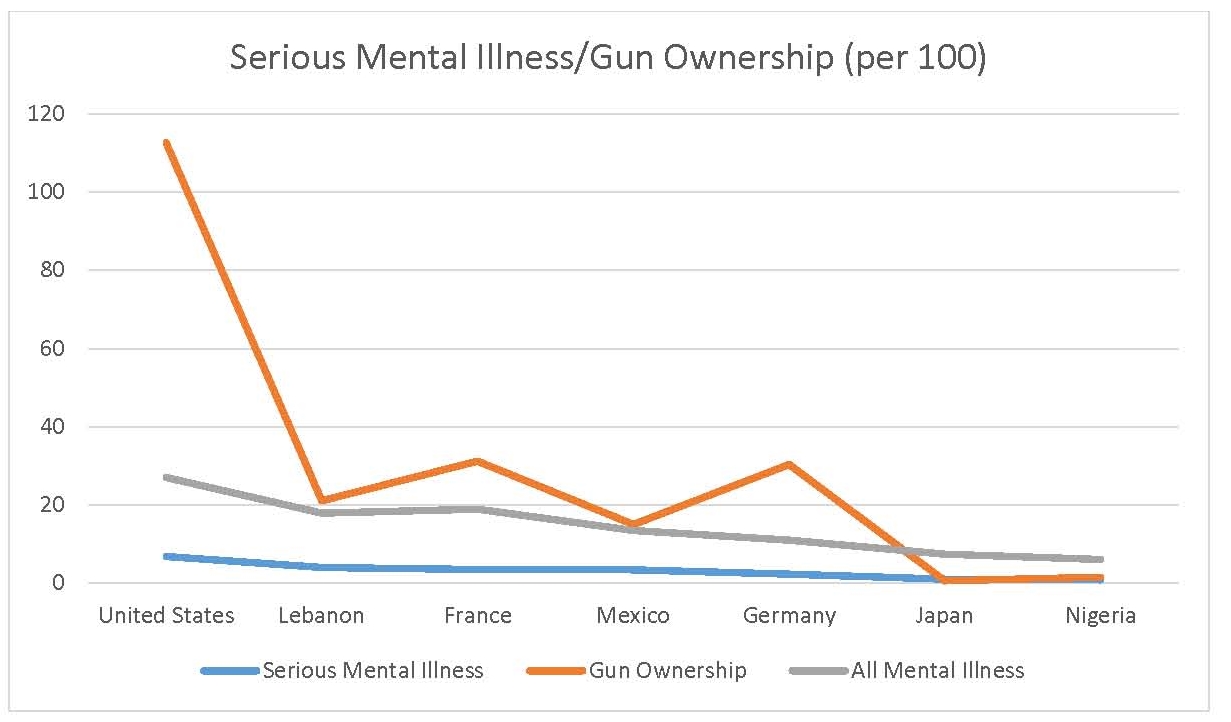
So many people, the mayor of Colorado Springs included, attribute these shootings to mental health issues that I thought I'd look at a comparison. So I chose a few countries at random across the spectrum of mental illness and looked at their gun ownership rates as well. Numbers are pulled from WHO and from Small Arms Survey. Note that Nigeria has plenty of mass shootings involving Boko Haram, and Mexico beats the US in murder by gun thanks to drug wars, but until two weeks ago in Paris, almost no one on this list offered much that would rise to the FBI's definition of an "active shooter situation." In the US, "70 percent of the incidents" occur in either a commercial or educational setting.

We have more people with serious mental illnesses than any other nation on my list—2.8 percent more than the next closest country, which is Lebanon. But we have a boatload more guns. It's a lethal combination.
Thursday, January 2, 2014

Health Care Costs

Here's Olivia's favorite author expounding quite accurately on American healthcare. Worth a listen.

Wednesday, February 27, 2013

Required Reading

It's not short, and it's not sweet, but it is unbelievably important. If you can't read it here, buy the magazine.

Thursday, September 27, 2012

Community Needs Assessment: Health

One nice thing about being on the board of TCA is the access to tons of data about the area. Every year they put together a comprehensive community needs assessment that contains charts, graphs, and stats on the county as a whole, particularly with regard to poverty. The figures derive from all kinds of places, from the U.S. Census to TCAD to the Housing Coalition. I'll post a few interesting stats from time to time. Here are today's.

In 2009, the number of uninsured persons in Tompkins County was 9,274, or 10.5 percent of the eligible population. That's a little under the 13 percent statewide or the 12 percent nationwide. (Source: U.S. Census Bureau) Births to teens in 2007 were 45, or about 5 percent of live births. (One of O's classmates just posted her sonogram.) Statewide, the percentage was closer to 7. That same year, only one new mother in the county received no prenatal care, and 3 percent received care only in the third trimester, compared to 5 percent statewide.

In Tompkins County, 8,251 people received Medicaid in 2010—about 81 per 1,000 population, or less than half the percentage statewide. As I've always contended, the county has a higher number of mental health professionals per 1,000 persons than the state as a whole (0.33 compared to 0.32), but our number of physicians and assistants lags behind the state average, at 2.68 per 1,000 compared to 3.99 per 1,000. We're behind in dentists and nurses too, but well ahead in physical, occupational, and especially massage therapists.

Tuesday, July 17, 2012

Affordable Care in Dryden

Paul came home with questions about a small business in Dryden and the Affordable Care Act. Here are the answers.

Because the business has fewer than 50 employees, it is exempt from employer responsibility for offering insurance. However, since it has fewer than 25 full-time employees and offers wages that average under $50,000, it could provide employee health insurance, pay at least 50% of premiums, and receive a tax credit of up to 35%, increasing in 2014 to 50%. It will also be eligible in 2014 to shop at the Affordable Insurance Exchange to receive more choices and lower prices—similar to the buying power that large businesses currently have. If the employees it is insuring feel the cost is too high, they can take the employer contribution in cash and apply it to their own chosen health insurance plan from the Exchange.

Because it is so small, the Dryden business may decide to continue without offering insurance. Employees will be able to buy insurance directly on the Exchange, starting in 2014. If they make under $14,000 (or $29,000 for a family of four), they will be eligible for Medicaid. If they make under $43,000 (or $88,000 for a family of four), they will receive a tax credit that is advanceable (to lower monthly premiums). They may also qualify for cost-sharing of payments and deductibles. If they choose not to purchase insurance, they will pay a fee (now considered a tax), which will go to help pay medical bills for other uninsured Americans, a fee that every taxpayer in the nation currently helps to pay.

Thursday, July 5, 2012

How Does the SCOTUS Decision Affect Me?

In my working life, I've had maybe five different insurance plans, including at least two different self-purchased plans. We signed up for our current plan prior to 2010, which means that we are grandfathered in under the Affordable Care Act. As far as I can tell, the changes for us are these:

1. Olivia can stay on our plan until age 26.

2. We no longer have a lifetime limit on coverage.

3. We can't get dropped if we get sick.

4. Our premiums may increase, but they can't suddenly skyrocket.

I thought we'd get free immunizations, but there's some discrepancy in what I'm reading. It appears that grandfathered plans aren't forced to provide free preventive care.

All in all, it doesn't seem to affect me much, at least not the way the screaming right wing would suggest. I don't much feel that my freedom is affected one way or the other.

Friday, March 30, 2012

Required Reading

I haven't had the courage to tackle the Supreme Court discussions this week, so I'll just post this piece Simon found. The truth about the American system of medicine, from a Canadian-trained doctor.