Showing posts with label world affairs. Show all posts

Thursday, July 7, 2016

The Death of Supranationalism?

At my core, I'm a one-worlder, in the supranationalist sense of the word. I'm not into world domination, but I do think that things such as income inequality, climate change, and peace can never be solved nation by nation.

It's that kind of supranationalist thinking that led in the 90s to trade agreements that have sent a lot of lefties into a sudden nationalist tizzy. Even though it's ostensibly the right wing that wants to eliminate the EU and close our borders, a surprising number of people on the left are clamoring for similar changes.

Nationalism sucks; it gives us border clashes and independist wars. It's not a natural construct; in many cases, "nation" is held together by a strongman dictator; remove the dictator, and the nation flies to pieces. Nationalism is the reason I cringe when I hear Trump spout the old anti-Semitic "America First" line, or when I hear references to American exceptionalism. We fly a flag at our house to counter the nasty elements of nationalism that popped up in the flying of flags post 9/11. I like America, but it's an America of my own construct, not the one you all impose on me.

If the pendulum toward free trade is now moving back in the other direction, we can expect what we've seen this year: nativism, sabre-rattling by white supremacists, reduction of political freedoms.

The problem I didn't foresee with free trade was that it meant corporate world domination. The one world we got wasn't an end-of-days Narnia run by a free population of diverse but loving human beings. It was a worldwide dominion controlled by a few monopolies, with the "common good" way, way down on the list of priorities. There is not a chance that such a ruling structure would address income inequality, climate change, or peace.

If the pendulum toward free trade is now moving back in the other direction, we can expect what we've seen this year: nativism, sabre-rattling by white supremacists, reduction of political freedoms.

So what now? We retreat to within our borders and make widgets no one wants as a means of achieving full employment? We hoard our own water while the rest of the world burns? We stop educating and feeding the world? We wall everyone out, deny our own diversity, and pretend we are the Aryans of de Gobineau's fantasies?

It's a creepy, sad time in America, a time when one political candidate has enabled our dormant racism and xenophobia to awaken, full-throated. Since history tends to go in cycles, some day we should swing back toward a freer, more collaborative world. I truly hope it's not too late.

Tuesday, May 31, 2016

Mom-Shaming

As someone who once lost her two-year-old for a paralyzing eight minutes in Baltimore's bustling Harborplace, forgive me if I'm a little sympathetic to the doxed and shamed mom of the kid who fell into the gorilla pit at the Cincinnati Zoo, leading to the death of a beloved 17-year-old ape. I get it: The gorilla was just being a gorilla. They could/should have drugged him (although it would have taken ten minutes to take effect, and who knows what that ten minutes would have wrought). Online chatter went ballistic with everything from racist blather to calls for the lazy, incompetent mother to be jailed. The fact that the dad was there, too, is only mentioned occasionally. Because we all know that any accident befalling a child or bad behavior emanating from a child is 100% the mother's fault. Today, in 2016.

It's exhausting.

Friday, December 18, 2015

Physician, Heal Thyself

Desperately poor, hostilely stereotyped, restricted from accessing reproductive health services, over-incarcerated, #72 globally in governmental representation with increasing maternal mortality...

There's nothing we love more than carping over cruelty to women in other nations, particularly those that cover women from head to toe (hijab or burka bad, wimple or habit apparently fine), but the recent report from the UN Working Group on discrimination against women had some awful things to say about women's treatment here at home.

Three delegates, from Costa Rica, Poland, and the UK, spent 10 days in three states looking at policies, attitudes, and systems, and boy were they surprised. Pregnant women don't have maternity leave! Violence against women often includes guns! Vigilantes attack women at clinics!

But the worst thing of all, according to Huffington Post's interview, is that American women retain a deep-seated but demented belief that we're better off than women elsewhere. I suppose that's what gives us the self-righteousness to challenge other cultures' bad behaviors.

Monday, November 30, 2015

Untreated Mental Illness Plus Guns

After Aurora, a Colorado Springs reporter wrote, "James Holmes, the man accused of killing 12 people and wounding 58 at an Aurora movie theater, was seeing a psychiatrist at the time of the July 20 attack. If he’d been in Colorado Springs, chances are he wouldn’t have gotten even that much help."

After an October incident in Colorado Springs where a guy with a rifle and gas cans opened fire on civilians in the street, the local gun-nut mag noted that someone with an open-carry gun plus gas cans might be worrisome and require some level of serious response even as they applauded the mayor of Colorado Springs for not budging on the open-carry law.

Now that same mayor says about the most recent mass killing in Colorado Springs, the second in a month, that "one of the things we don’t do very well is identify these people, sometimes with mental health problems, and prevent their access to weapons."

Well, yes. We don't identify them, we don't treat them, and we don't prevent their access to weapons.

Adam Lankford at the U of Alabama has done the most interesting recent work on mass killings. He used a definition of four or more kills, meaning that the recent Colorado Springs shootings wouldn't even appear on his radar. (The FBI uses three or more.) Nevertheless, he found that the US accounted for 31 percent of mass shootings, and that the only real predictive correlation with any meaning was our firearm ownership rate.

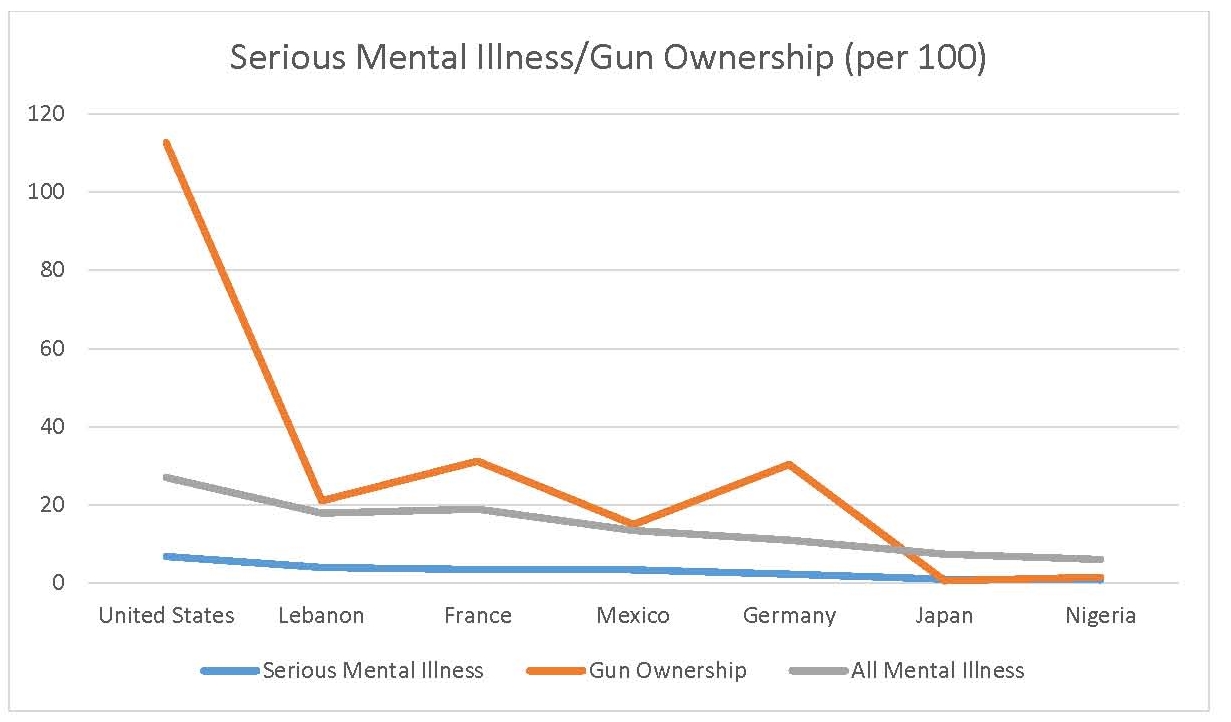
So many people, the mayor of Colorado Springs included, attribute these shootings to mental health issues that I thought I'd look at a comparison. So I chose a few countries at random across the spectrum of mental illness and looked at their gun ownership rates as well. Numbers are pulled from WHO and from Small Arms Survey. Note that Nigeria has plenty of mass shootings involving Boko Haram, and Mexico beats the US in murder by gun thanks to drug wars, but until two weeks ago in Paris, almost no one on this list offered much that would rise to the FBI's definition of an "active shooter situation." In the US, "70 percent of the incidents" occur in either a commercial or educational setting.

We have more people with serious mental illnesses than any other nation on my list—2.8 percent more than the next closest country, which is Lebanon. But we have a boatload more guns. It's a lethal combination.

Thursday, November 19, 2015

Find a Better Example

REFUGEE (n.): A person forced to leave his or her country to escape war, persecution, or natural disaster.

Want to keep refugees out? Find a better example.

1980, Cuban Refugees:

"But some of them might be Communist!"

1840, Irish Refugees:

"But some of them might take my job!"

1615, European Refugees:

"But some of them might have smallpox!"

DING DING DING We have a winner!

Monday, November 16, 2015

Tuesday, May 5, 2015

Parental Choice and Local Control: A Cautionary Tale

Swedish schools were once held up as a model. Then came a series of reforms that enabled parents to choose schools via vouchers. This free-market system was designed to provide competition that would vault Swedish education into the stratosphere. Instead, student scores on the PISA plummeted, teacher morale declined, and segregation increased. Instead of a well-balanced system of equivalent schools, Sweden ended up with a mess of haves and have-nots with little oversight of the educational system as a whole save at the city council level. A new OECD report encourages Sweden to go back to the drawing board, to "establish conditions that promote quality with equity," to "support high-quality teaching and learning," and to develop a more nationalized vision of educational priorities. The locally verboten words data and accountability are thrown around a good deal, as one would expect from a think tank. But the disastrous results in Sweden over a dozen years of poorly regulated school choice should be a warning to those who support vouchers and charters.

Thursday, April 23, 2015

Reading List

The author was called both too pro-Israel and too anti-Israel by reviewers, which probably means he's on to something. Don't read it if you're looking for The Answer. But he's very smart and thoughtful and writes like a dream.

Saturday, December 6, 2014

If You See Something, Say Something

Too many people are busily attributing bad behavior on the part of the police to "a few bad apples." But you know that if you have one rotten apple in a barrel of apples, eventually ethylene gas from the rotter will ruin all the perfectly fine apples in the barrel. It's time to snip the thin blue line and get decent cops to rat out lousy ones, in much the way that fraternities and members of the armed forces are now being asked to stop sexual assault via bystander intervention.

I get that it's a tough sell. The bro mentality is strong and resolute from childhood. It's reinforced on sports teams and in scouting programs. But it sucks, and eventually it will destroy the very institutions the bros are trying to protect. The danger may be greater from within than from the unknown terror outside.

Wednesday, November 12, 2014

Flash from the Past

For Cornell’s sesquicentennial, each college gets a month in which to supply the community with an event of the college’s choosing. Arts & Sciences started things off in November with a three-day symposium on The Vietnam War at Cornell. I attended the teach-in, which featured former students and professors reminiscing about their experiences plus an advanced screening of a film-in-progress about the takeover of Willard Straight Hall in 1969.

Professor Kramnick was careful to invite former SDSers as well as men who had fought in Vietnam, for a balanced perspective. The most affecting five minutes were from a one-time professor, who wept when he remembered a favorite student’s death in-country—a student who only enlisted because he was convinced that to argue more persuasively for peace, he needed to experience war.

Although I was younger than most of the people in the room, much of the two-and-a-half hour event resonated with me. There was Dave Burak '67 (below), who enlisted Mark and me and Winnie Rossiter and others into Junior SDS. One participant recalled the Barton Hall “America Is Hard to Find” event in 1970, when the sudden, unexpected, and daring appearance of Dan Berrigan lit up the room before he was spirited away into the underground again, disguised by friends from Bread & Puppet Theater. I was there. Paul was there. Our families were there.

The footage from the documentary reminded me of things I’d long forgotten—the long meetings of faculty at Bailey Hall as the university tried to decide what to do about the appearance of arms on campus, the way in which town and gown divided and the children of professors were forced to take sides on issues that were certainly over our heads at the time.

This was a time that would soon blow up families I knew—the Rossiters and the Perkinses, among others—not to mention the families of boys who went away and never came back, or moved to Canada, or went away and came back changed. Yes, I was alive for JFK’s assassination, but it’s the antiwar era that left its mark on me. Olivia’s generation has nothing comparable. Take away the draft, and war is rendered hazy and impersonal.

It was interesting to be in a roomful of people who shared the same points of reference.

Saturday, August 16, 2014

Our Tolerance of Intolerance

I'm a white woman and thus unqualified to speak about the plight of Michael Brown or Ezell Ford or Jonathan Ferrell or Eric Garner. I was teargassed and chased by police in my day, but it was because of what I was doing and saying, not because of how I looked. But now that Ithaca has joined the ranks of places where white policemen and African-American boys and men collide, it's hard not to think about it constantly.

Although anyone who's been through middle school knows that a gaggle of white girls is the biggest force for evil on the planet, had my daughter and some of her friends been riding around near the site of the Ithaca arsons, she never would have been followed and stopped by a cop. It simply would not have happened. My kid sees guns in hunting season and on TV. The thought of her seeing a strange man pull a handgun around her, even if it was in fact "pointed in a safe direction"—well, it doesn't bear thinking about. As a parent, I can imagine the parents' fear and horror, but all I can do is imagine it, because it won't ever happen to us.

I'm always aware of white privilege, although as someone whose relatives died in the gas chambers of eastern Europe, I honestly don't often translate it into white guilt. My daughter identifies as Jewish, which led throughout her school career to some ignorant shaming by teachers and classmates. She came home once to report that a teacher had made her teach the class about Judaism when they came to that part of the Religions chapter in history. The joke was on the teacher, because my kid (to my shame) knows as little about Judaism as most of her classmates did, although she has a good imagination and is always willing to make stuff up. But although she thought it was funny, I thought it was horrible. Would the teacher have had an Asian-American student teach the lesson about the Han Dynasty?

It is hard for me to see the same people who cannot differentiate "Hamas" from "all Gazans" call on us all to be tolerant of looters in Ferguson, pointing out that it's just a small group of bad-actors and should not reflect on the population of protestors as a whole. That's true, for sure, but it's curious how our tolerance of intolerance is a direct reflection of ourselves, our upbringings, our experiences. For me, looters = Hamas, and other protestors = other Gazans. But of course, I'm not a real Jew; I'm Jewish on my father's side, and we were never religious. Where my father had to run away from gangs of Italians and Irish, I was instead belittled by people who denied half my heritage. So maybe my intolerance of people's intolerance toward Gaza is a reflection of my non-Jewishness—or my anger at those Jews who pointed it out incessantly.

I belong to a very multicultural extended family—white, Christian, Jewish, Latino, Asian, African-American. Somewhere on my mother's side is an Inuit great-great aunt. You would think that I'd be pretty tolerant and unbiased. But as my daughter can tell you, my biases are political, and they are fierce. So I don't pretend to be better than anyone else when it comes to this stuff.

I don't plan to prejudge the police officer who was involved in the Ithaca incident. Anyone who has ever felt threatened, rightly or wrongly, knows that adrenaline can lead you to do stupid things. A lot of people are concerned about the militarization of our police forces, and I am too, but I don't think it can be solved until we demilitarize bad-actors. But gun control is probably a topic for another day. Right now, I'm just thinking about those teenagers and their parents and the police and fear and race and expectations and beliefs and ignorance. We like to think of our little corner of the world as a pretty open and tolerant place. Yet when my brother's former girlfriend moved to Ithaca with him for a year back in the 1980s, she found it the least tolerant place she'd ever lived—and she had lived in half a dozen countries and many large cities. People threw things at her from their cars as she walked to work, and as a mixed couple, they were often verbally harrassed. She was thrilled to move back to the big city.

My daughter will never know what that is like, to be abused for the color of one's skin. On the other hand, she knows what it's like to be called a "Jew Whore" (by an African-American classmate, as it happens) and to be humiliated by teachers and students when she suggested that selling Easter candy (complete with crosses!) was an inappropriate school fundraising activity.

We're none of us immune, but some of us are more likely to die due to other's intolerance. Right now, being a brown-skinned male means having a target on your back. And that should be intolerable to anyone with a conscience.

Thursday, January 30, 2014

Required Reading

"... a new strain of racial, ethnic, and cultural reductivism has crept into the American psyche and public discourse."
Mehta taps into something distasteful with this short, thoughtful look at America's new "model minorities."

Sunday, December 15, 2013

Prescience

Shortly before he died, Cornell's Carl Sagan taped this prescient interview.

Monday, September 9, 2013

It's a Gas

What makes one kind of weapon worse than another? We can't really ask the folks who die, "Would you rather have been shot through the head?" Is having your limbs blown off and dying slowly in agony really better than inhaling toxic gas and dying slowly in agony?

Why is gassing Syrians in 2013 worse than gassing Iranians in 1983? Is gassing Kurds worse when Iraq does it in the 1980s than when Britain does it in the 1920s? Why do we hear so much about the Germans' use of chlorine and mustard gas in World War I and so little about the American and British use of phosgene in World War I? The Japanese gassed the Chinese during the Sino-Japanese War. Hafez Assad gassed Syrians in the 1980s, with the Reagan administration's wink and nod—better a Westernized dictator than those Muslim Brotherhood boys. What is it about gas—some gas—that makes us so queasy?

The Germans gassed Jews and Gypsies, the Croatians gassed Serbs. We killed our own prisoners with gas from the 1920s to the 1990s. Wikipedia suggests that the excessive twitching and drooling of the decedent makes the whole thing particularly icky for the viewers. I guess in comparison, electrocution is kind of pleasant, and the firing squad is a day at the park.

Perhaps our red line should have to do with the action and not the methodology. Just a thought.

Monday, August 27, 2012

The Unluckiest Fellow

Could Mitt Romney be the unluckiest guy on the planet? It hardly matters that Tropical Storm Isaac won't splatter Tampa--The GOP has already postponed Day 1. What matters far more is that Isaac seems determined to ram New Orleans, which is guaranteed to raise the specter of Republican Presidents Who Failed Us. The only possible cure is for Iran to capture a bunch of embassy workers during the Dems' Charlotte convention. Not that I'm recommending that (for one thing, we no longer have an embassy there). Gee, Mitt, what did you do to deserve this?

Monday, January 23, 2012

Syria, Revisited

My 2010 book for kids on the Assads ends with the questions:
Can Bashar turn Syria's economy around in time to save the country from an internal coup? The history of Syria's nationhood sets the odds against his success. Will he return to the reforms of his first year in office? Crackdowns on journalists, teachers, and activists since the early 2000s make that openness seem a distant dream...[Bashar's] choices over the next few years could mean the difference between war and lasting peace in the Middle East.
Hardly prescient, given the realities in Syria. My outside reader on the book was Joshua Landis, co-director of the Center for Middle East Studies at the University of Oklahoma, and his blog remains the best site I know for finding out what's really going on in that benighted country. His inside contacts, friends and in-laws alike, give an angle on the news that you just won't get on CNN, and he has links to many other useful sources. If you want to know about Syria, start there.

Tuesday, November 22, 2011

Hypocrisy R Us

How grotesque is it that we continue to encourage Arab Springsters to emulate our democracy and to forgo police violence at a time when our Congress is at a standstill and our cities are gassing their citizens?

Sunday, October 16, 2011

"May Your Occupations Be Few..."

"...If you would lead a tranquil life." Well, Marcus Aurelius wasn't thinking about this kind of occupation, but the word occupy has been thrown around so thoroughly over the past few weeks that it seems that our tranquil life is a thing of the past. We're occupying everything from Cortland to the Library Book Sale. It's only a matter of time before Madison Avenue picks it up and we're occupying McDonald's or our local Kinney Drugs. Co-option is just minutes away.

Before that happens, though, I have to express my delight at OWS and its worldwide spawn. I grew up in a moment in time when occupation was a standard tool. In my first occupation, I occupied the IHS Board of Ed building to get a smoking area placed outside the cafeteria. (Yeah, imagine that happening today. But it worked.) At Cornell, students occupied Willard Straight Hall. My friend and editor Chuck occupied the president's office at Columbia.

I have always thought that the most important political goal in America must be decreasing the economic divide. That has led me to unfortunate decisions (supporting John Edwards, for one) and has somehow never caught on as a sexy issue with the politicos in power. It was always going to be an idea that percolated upward from below, so the natural evolution was always likely to be the kind of quiet revolution that OWS represents.

Is it the start of something real? Maybe. Maybe some of the students in tents in the park will be stimulated into organizing locally, running for local office, or supporting people like Elizabeth Warren for Senate. Occupation can be a focusing lens; when you are surrounded by like-minded people arguing over ideas, the result can be a lifelong pattern of deep thinking and community action. Or reading history! As Chuck wrote to me after his visit to Zuccotti Park, "It’s interesting... to think that back in the day, we thought of ourselves as the heirs of a vital leftist tradition, bolstered by decades of intellectual ferment and by ongoing exemplars of revolution in the Third World (even if later these mostly proved to be false). Today’s protesters don’t have any of that to lean on. They have to make it up out of whole cloth...."

Today's protesters may look at the disparity in power between players in the Arab Spring and think, "If they can do it, so can we." My guess: It's easier to overthrow a government than to get corporate America to share the wealth. Which does not mean, in any way, that we peasants should stop trying.

Wednesday, July 27, 2011

Post Office Closings

Despite the news that most 2011 post office closings would be small rural sites, the list for New York contains mostly city offices, with the occasional tiny town. Surprisingly, this county is unaffected.